
Breathing. Have you ever thought about it?
Breathing is the process by which a living being takes oxygen from the air and expels carbon dioxide, allowing cells to produce energy.
On average, an adult breathes between 12 and 20 times per minute at rest.
If you do the math:
- 12 breaths/min = 17,280 breaths per day
- 20 breaths/min = 28,800 breaths per day
So, the normal range is roughly 17,000 to 29,000 breaths a day. But it is something we take for granted because it happens automatically, right? Today I will take you down the path of breathing, and we will see where it leads us.
When you practice meditation (which is closely linked to breathing), whatever type you are practicing, one of the best things you develop is focused attention. And you realize that by working with breathing, its rhythms, and focusing on it, you can connect with your emotions and with the typical mental wandering we have all day long (the monkey mind that jumps from branch to branch).
Over time and with practice, I realized that meditation—seated or in zazen—is a wonderful way to focus attention, and that is why it is part of the essence of Buddhist practices. But you can bring that same attention to other everyday situations.
Of course, the benefits of meditation have a biological explanation beyond the spiritual side. We find the answer in neuroscience (which is very trendy, by the way).
Over the last two decades, there has been increasing discussion about breathing and how being aware of this process—which we normally run on autopilot—helps us focus better, reduce anxiety, and so on.
I went from meditating with a focus on attention to wanting to apply different benefits of breathing in other areas of my life. Most immediately, in two situations: (1) when I needed to calm down because I was angry or very nervous, and (2) when I wanted to sleep better.
Although you can do it yourself with 4 x 4 breathing (inhale, hold, exhale, hold), for example, when you need to steady yourself, or 4 x 7 x 8 (inhale, hold, exhale) when you want to sleep, I came across a wonderful app by a developer in India, to whom I donated money for the amazing thing he has created completely free of charge. It is called: «Breathe».
After using it for a long time, on the recommendation of Matt Mullenweg, in a post (Work with music), I came across another technological marvel for mental wellbeing: Endel. I bought the lifetime plan because I love it and use it in so many situations in my life, from focusing better while working to sleeping.
It also includes a series of simple guided meditations that help you work with your breathing.
I believe that, as with everything, it is important to move forward without these tools afterwards. But at the beginning they are great, and they do help us create regular practice spaces; there is no need to be closed-minded about it.
After some time with these different practices, I noticed for myself how something as simple as breathing can generate such a powerful physical and mental change that I still find it hard to understand why it is not taught to children.
Later I came across a very distinctive character, the famous Iceman: Wim Hof , who has a series of techniques focused on cold exposure and a type of breathing that I will tell you more about later.
If you have not seen anything about Wim Hof, I highly recommend it. While it is true that his book (The Wim Hof Method) tends to dwell and expand a bit too much, his theories are very simple, yet with an interesting scientific backing, despite many detractors.
Wim believes we have lost our ability to survive in extreme environments. Therefore, the things we have built to make life easier have weakened us. In a way, it reminds me of the stoic practice of discomfort in Stoicism.
Wim Hof, a guy with an incredible personal story—which I will not spoil—proposes a method built on three pillars:
- Cold
- Breathing
- Mental attitude = the commitment to oppose your ego.
I will tell you more about the type of breathing he proposes later.
Regarding cold, the book cites various scientific studies showing how this person is able to boost his immune system and even fight diseases that were injected into his body thanks to his method.
Mental note: Wim reminds me a lot of my father. Possibly that is why I connected with his message. You can see the Dr. La Rosa’s opinion in his video on why the method works, and a fantastic interview Rubén did on the El Sendero en español channel (because yes, he speaks Spanish among many other languages).
At first, I was a bit skeptical, but I have been practicing cold exposure for years, and it not only helps me mentally (the main benefit), but I also do not usually get sick or catch colds. There may be some truth in our grandmothers’ saying: «A cold shower a day keeps the doctor away».
We will come back to Wim, from whom I kept only the cold practice, ignoring the breathing part, which is what concerns us on this path.
The answer from neuroscience and all the influence of breathing came (for me) a few years ago with the wonderful book by Nazareth Castellanos: «Neuroscience of the Body: How the organism sculpts the brain», who has devoted her career to understanding the relationship between meditation and the brain.
Her writing is simply incredible. It tells a wonderful story of science to help us understand ourselves.
Her latest book, «The Bridge Where Butterflies Live: Biosophy of Breathing», is a beautiful story—a tale of the journey of self-knowledge and of becoming sculptors of our own brain.
After many authors such as Timothy Gallwey (The Inner Game of Tennis), Japanese Buddhist monks such as Shunmyo Masuno and Taisen Deshimaru, India’s Ramana Maharsi, and even the Stoics, they all speak of breathing as a way to control our energy.
Until I came across the book that addressed it in a more comprehensive way: «Breath: The New Science of a Lost Art», by James Nestor.
A true gem that helps you understand that:
«Breathing allows us to access our own nervous system, control the immune response, and restore health.»
James takes us through historical studies, different traditions, and experiments to help us understand how certain changes in our diet (chewing much softer industrialized food, for example) have led to so many breathing problems today.
According to James, breathing «is a switch for a vast network called the autonomic nervous system». And he states that we breathe too much (in volume), and that is part of the problem. So he proposes that:
«The optimal breathing rate is about 5.5 exhalations per minute. This means inhalations of 5.5 seconds and exhalations of 5.5 seconds; that is perfect breathing.»
So I had in my hands yet another breathing method, which I started to practice every day. A year later, I can only speak highly of it.
With another super-simple app called «Paced Breathing», by a Romanian developer, Mihai, I set 5.5-second inhalations and exhalations, without pauses, just as James suggests, and the feeling in my body right after finishing is wonderful.
On this path, I have realized that, indeed (and like my son), I tend to have poor mouth breathing, which wreaks havoc on our body.
By being more aware of it, I try to keep my mouth closed more and follow breathing patterns that I observe and, above all, feel their immediate benefit in my body.
All the research is not far from many Eastern traditions, such as yoga or Buddhism, which found in the body and breathing a way to improve our mind—living more in the present and learning to detach from the ego.
In James’s book, he mentions the case I had already written to you about before: Wim Hof’s theories, which, as I pointed out, were based on cold exposure and a breathing method that I initially ignored a bit, but when I understood everything behind it, I started to implement it—and as I said, I have been doing it for more than a year, and the change in my attitude and body is incredible.
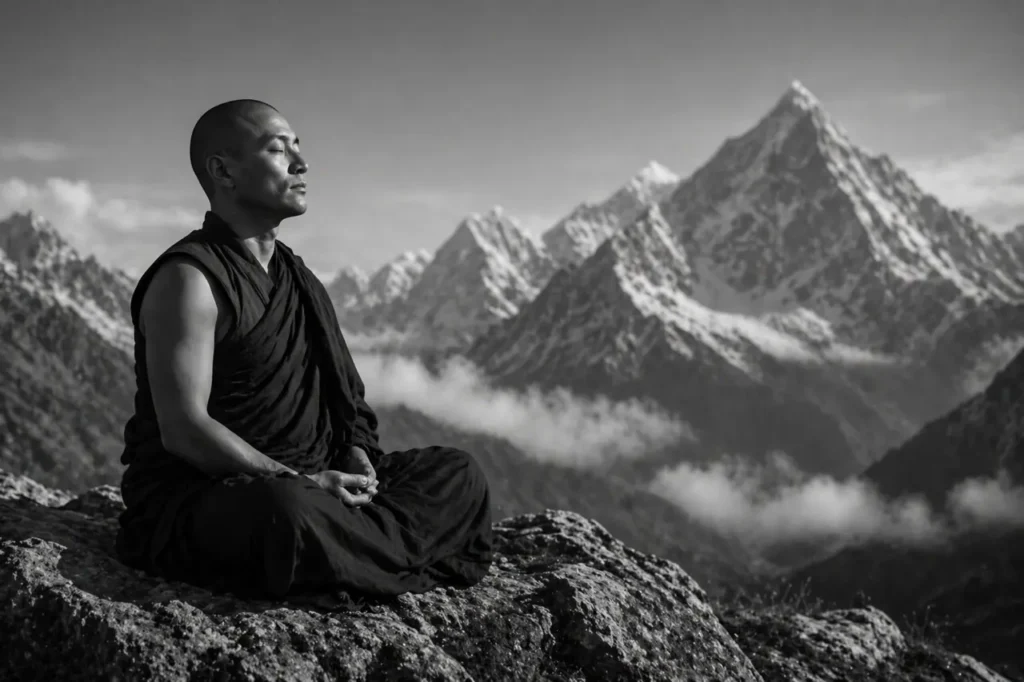
Tummo Breathing
Wim Hof brought tummo breathing to the Western world. And what is it?
Tummo breathing (also called «inner fire») is an ancient technique of Tibetan Buddhism, especially within the Vajrayāna Buddhism tradition. Its goal is to generate body heat through breathing, visualization, and mental concentration.
The idea is to activate a kind of «inner energy» that rises through the body, generating heat and deeper states of consciousness.
It became famous because some monks were able to meditate in extreme temperatures, and it was studied by scientists such as Herbert Benson, who documented the effect of this breathing.
It is credited with benefits such as:
- Improved stress management
- Greater concentration
- Regulation of the nervous system
- A sense of energy and mental clarity
So Wim Hof’s approach is clearly influenced by this type of breathing. As James Nestor notes:
«In this breathing, the body strains, entering a state of stress for a minute and a state of extreme relaxation the next. Blood carbon dioxide levels plummet and then recover; tissues experience an oxygen deficit and then are re-oxygenated. The body becomes more adaptable and flexible and learns that all these physiological responses can be controlled.»
I admit that until I read Nestor, Wim Hof’s breathing practice had not inspired much confidence or interest in me, but I wanted to give it a chance, and today I can say it is incredible.
After doing it, I am left with a feeling of deep relaxation in my body, and it is part of my «essential tools» to lift my mood, have more peace, less stress, and so on.
Also, as James points out, the practice of intense breathing, together with regular cold exposure, releases the stress hormones adrenaline, cortisol, and noradrenaline. From what I can see, it is all nothing but benefits.
Of course, all these benefits carry over into every area of my life: personal, as a partner, as a father, and even professionally, because running a service business is very demanding and can burn you out very easily.
I will leave you the video of the Wim Hof method so you can give it a try. It is based on a simple but not very intuitive method:
- Deep (abdominal) breathing, filling the belly and expelling the air at the same speed (more forcefully than the inhalation) for 30 cycles.
- As James and Wim say, «Each breath should be like a wave; the inhalation should inflate the stomach and then the chest, exhaling to finish naturally, but leaving a quarter of the air in the lungs, then holding the breath for as long as possible.»
- I let Wim Hof’s voice guide me. I prefer it in English to the translations on YouTube, but it is a matter of taste.
I recommend that you sit comfortably, with your bare feet on the floor, try not to move, and use headphones.
At first it will be hard to follow that breathing pattern; it is as if your body «rejects» that level of stress. But the tingling sensation after finishing the three rounds is hard to describe.

It will also help you be more in touch with the present. So let us not take anything for granted—experiment with an open mind.
And as Wim Hof says, I wish you a good day and a good life: «All the love, all the power».

